







How AI Will Change the Workplace
We asked some top thinkers from different fields to weigh in on what’s ahead, as the AI explosion compels businesses to rethink, well, almost everything

 11 min
Artificial intelligence has been affecting how we work for some time—helping to craft job postings and evaluate applications, judging how efficiently we complete jobs and, for gig workers, determining assignments and pay.
But in the past year, and especially the past six months, generative AI has supercharged the potential of technology to help, hinder or reorient how we work. Visual tools like DALL·E 2 and Midjourney may drastically change graphic design. Large language-model text generation, beginning in earnest with the release of ChatGPT, promises to affect every activity that involves touching a keyboard.
To learn more about how the worlds of work and AI will interact, we spoke with experts in computer science, human resources, recruiting, corporate leadership, psychology and more. Here are some of their predictions.
Automating ideas
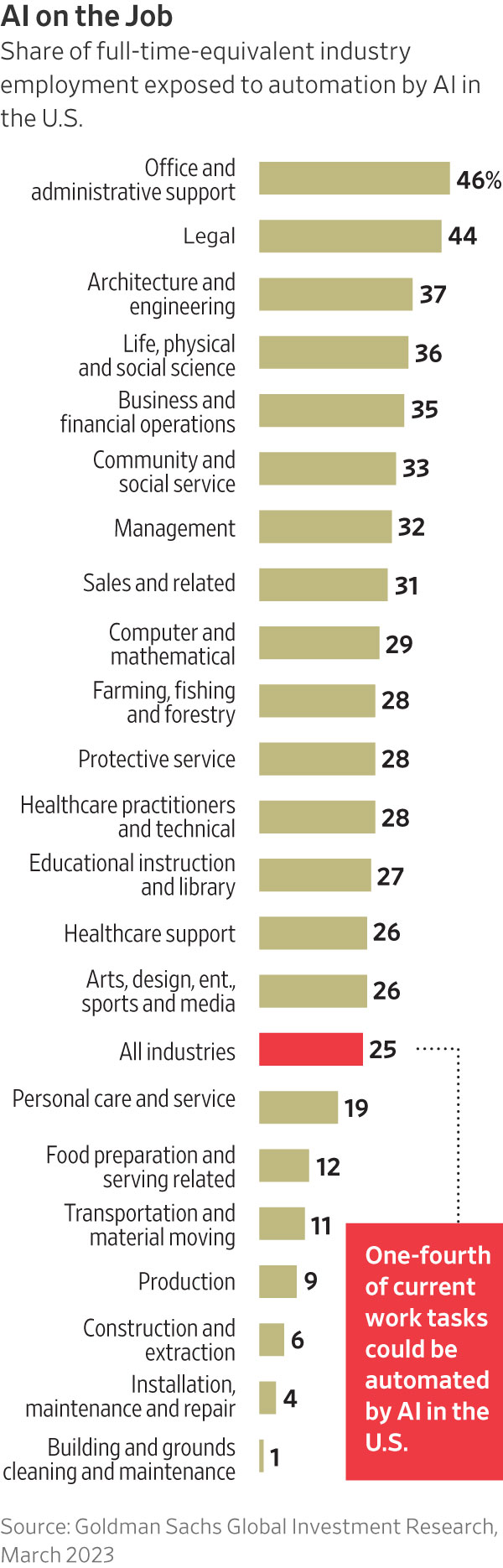
AI will continue the current process of automating parts of workers’ jobs. But while today’s automation is often described as applying to dull, dirty and dangerous tasks such as moving parts in a factory or warehouse, generative AI brings a new dynamic: Primarily, it supports knowledge work by providing the ability to create first drafts of documents, emails, presentations, images, video, product designs, etc.
So, knowledge workers might spend more time editing than creating, particularly as generative AI is embedded into all the software products they use today. For instance, instead of an email system just typing ahead a few words, it could draft several paragraphs. Customer-relationship-management software could suggest topics to discuss with a sales prospect and even a script to follow. And a salesperson could describe a presentation in natural language, and draft slides could be created, accessing corporate data and images to fill out details.
But there are some GenAI applications where the potential to have transformative impact really comes to the fore: For example, in research and development, some experiments using generative AI to support writing software code have shown very high levels of increasing productivity. But that doesn’t mean we’ll need a lot fewer software engineers, because the world needs more software. Generative AI also has the potential for improving the productivity of contact centres. There already were technologies that could automate interactions with customers; generative AI has the potential for making these interactions feel much more natural.
—Michael Chui, partner, McKinsey Global Institute
Flatter organisations
Artificial intelligence is likely to flatten many organisations due to its ability to automate work activities. Right now, most organisations have entry-level people who perform routine tasks, midlevel individuals who supervise them and high-level employees who set the direction of the organisation.
That organisational structure will no longer be necessary. AI can automate many of the tasks performed by entry-level workers. Accounting features, purchase orders and job requisitions are already being automated, and workplaces no longer need people who manually compile or analyse information.
As generative AI becomes more widely deployed, even more tasks will be automated. In addition, job supervision and assessment won’t need as much human oversight. Customers can rate employees on how well they perform basic tasks and allow people to get the services they want. Using data analytics and AI, companies can use the responses to weed out low-performing workers and reward their top individuals. The end result will be fewer layers of management and a smaller number of employees overall in the organisation.
—Darrell West, senior fellow, governance studies, Brookings Institution
How human are we? Machines will tell us
In the past, managers turned to software to judge workers on technical matters—counting keystrokes or time away from the screen. Now companies are using machines to judge how much empathy their employees show.
I was recently sent a “management tip of the day,” advice on how to prepare for a job interview conducted by an artificial intelligence—a process that is all too common these days. A good score required that I appear “natural” with the machine, defined as injecting “authenticity and humanity to the interview.” It seemed a through-the-looking-glass request. A machine would be judging me on qualities that only human beings can exhibit.
The AI judgments don’t end with interviews. It is increasingly common for corporations to use AI programs to monitor employee empathy on the job. For instance, in call centres, AI programs coach and score workers on an empathy scale to judge their performance with callers.
With the addition of ChatGPT to a full suite of office products, texts, emails and calls, there is no limit to the interactions that may be judged by pretend-empathy machines. They will pretend to understand jealousy, competition, depression and insecurity, all the messy human feelings that come up in the life of a firm.
When machines test us on how we respond to such human complexities, high scores may go to those who exhibit qualities that machines value most—consistency and a bias toward tidying up what seems messy. Those who don’t stack up may lose their jobs.
It is backward thinking: Technology redefines human empathy as what machines can understand. Having built the machines that will judge us, now we will train ourselves to please the machines.
—Sherry Turkle, author and Abby Rockefeller Mauzé Professor of the Social Studies of Science and Technology, Massachusetts Institute of Technology
A threat to ethics
We are already seeing the rise of digital assistants that speak with a human voice and can use human appearance and social intelligence to negotiate disputes, brainstorm business strategies or conduct interviews. But our research illustrates that people may act less ethically when collaborating via AI.
Traditionally, teammates establish emotional bonds, show concern for each other’s goals and call out their colleagues for transgressions. But these social checks on ethical behaviour weaken when people interact indirectly through virtual assistants. Instead, interactions become more transactional and self-interested.
For instance, in typical face-to-face negotiations, most people follow norms of fairness and politeness. They feel guilt when taking advantage of their partner. But the dynamic changes when people use an AI to craft responses and strategies: In these situations, we found, people are more likely to instruct an AI assistant to use deception and emotional manipulation to extract unfair deals when negotiating on their behalf.
Understanding these ethics risks will become an active focus of business policy and AI research.
—Jonathan Gratch, professor of computer science, University of Southern California
An edge for the aged
AI will enable older workers to be seen, even by those with ageist eyes, as young again.
Younger adults tend to excel at work that uses fluid intelligence that involves analysis and solving discrete problems quickly. Older workers are thought to exhibit greater crystallised intelligence—the capacity to leverage experience and knowledge gained over years to quickly see patterns, nuance and emotional insights, and the capacity to determine which problems should be addressed and which are just noise.
AI is likely to provide a kind of augmented intelligence to older workers, enabling experienced professionals to fully leverage their talent and skills.
For example, AI will be an invaluable collaborator with physicians, speeding the collection and organisation of critical information such as patient symptom history, genetic profiles, medication interactions, as well as past successful treatment plans for similar conditions, etc. These systems will enable physicians of all ages to gather information quickly, but older doctors will be better equipped to apply their years of experience and knowledge to validate AI diagnoses and treatment recommendations.
AI will be more than a collaborative assistant to older workers. It will also be a valuable coach. The sheer growth and velocity of knowledge and technology is making training and upskilling essential. Unfortunately, many employers don’t invest in older-worker education. Now AI applications are being deployed in workplace education to address individual learning and knowledge gaps, helping older workers remain current and competitive.
—Joseph F. Coughlin, director of AgeLab, Massachusetts Institute of Technology
Navigating new tech
Today, most organisations suffer from a “digital dexterity gap,” where the workforce is largely unable to keep pace with fast-changing technology. Organisations have more technology than their employees are comfortable using, creating barriers to efficiency and productivity growth.
AI services strip away complexity. By using conversational interfaces and natural-language processing, AI removes the need for workers to master complex computer functions and menus. People simply describe what is needed, in nontechnical language, and refine their requests to get better output.
An employee, for example, could give an AI historical data and say, “Find and rank all the variables that will determine the market potential for this new product.” Before conversational interfaces were developed, getting the information would require a lengthy and complex series of interactions.
—Matt Cain, vice president and distinguished analyst, Gartner
An opportunity for building talent
As AI takes over routine tasks, there will be a temptation to cut the whole tier of entry-level employees: Summarising documents, answering routine emails, writing basic computer code and solving simple logistical challenges are all tasks that AIs can do about as well as an inexperienced human, and at much lower cost.
But employers still need an on ramp for new hires. If you stop hiring entry-level employees, you’ll have to do all your midlevel hiring from outside the organisation. And if every organization pares back on entry-level hires, it will get harder and harder to find experienced midcareer talent anywhere.
That’s why it pays to cultivate your own long-term talent pool by hiring green employees, but rethinking how they are tasked and trained. Instead of piling your juniors with grunt work and trusting that they’ll learn through observation, assign them more challenging tasks, like drafting reports instead of just summarising them—the explosion in AI research and writing tools means that kind of work is now well within the grasp of inexperienced hires. With more active coaching and mentoring, these green employees can grow into valuable colleagues, much more quickly.
—Alexandra Samuel, digital-workplace speaker and co-author of “Remote, Inc.”
The danger of following blindly
So many jobs involve writing standard responses—thank-you notes to customers, responses to job applicants and unfortunately term papers—that AI is instantly and easily used in almost every white-collar role.
The concern isn’t that the responses produced aren’t original or creative. How creative does a performance appraisal need to be? It is that if ChatGPT writes the report, the “author” hasn’t thought about it, hasn’t weighed the arguments and then come to their own conclusions in the text. They cannot explain to someone why the report says what it does, but they now have to live with its conclusions.
What happens when the ChatGPT report fails to include proprietary information that you could have found if you searched yourself, and it changes the conclusions? How do we explain to a subordinate why the appraisal written by ChatGPT gave them a lower score compared with last year, even though their performance seemed to be the same? The temptation to use it without thinking through the arguments and explanations could lead to big mistakes.
—Peter Cappelli and Sonny Tambe, professor and associate professor, Wharton School of the University of Pennsylvania
Big-picture thinking
Workers are already using ChatGPT to craft the perfect Facebook ad or tools like Descript to edit videos, but AI will get incorporated in more upstream work. AI will be in the boardroom, brainstorming sessions and planning meetings.
Imagine an AI system that runs global simulations and impact analyses for 5,000 different budget plans. Or an AI that proactively writes new code for you when it discovers that you have a bottleneck in your sales planning. Or a proxy AI trained on customer research that allows you to have simulated conversations with your target market. We’re moving from task-oriented AI to goal-oriented AI, and enterprises are looking to leverage it safely, securely and ethically.
—Allie K. Miller, AI entrepreneur, adviser and investor
Money management and the human touch
Many asset-management companies are now offering hybrid advisory services—involving both human advisers and algorithms—to their clients. But these new services are unlikely to reduce the demand for human advisers.
Instead, automation is expanding the market for financial advisers by making it more cost effective to serve clients with lower levels of wealth. Human advisers can now cater to more clients, since certain tasks, such as addressing simple customer queries and constructing portfolios, can be automated. As a result, asset managers are now hiring more human advisers instead of laying them off.
In addition, the requirements for a financial adviser’s success are changing. As more portfolio management is turned over to algorithms, technical portfolio-allocation skills are becoming less significant. However, it is becoming more important for advisers to explain how algorithms operate and assist investors in navigating turbulent market conditions. Our research shows that human advisers are still essential for customer satisfaction and retention because of their ability to reduce clients’ discomfort from interacting with algorithms and reducing clients’ uncertainty regarding the algorithms’ performance.
—Alberto Rossi, finance professor and director of the AI, Analytics and Future of Work Initiative, Georgetown University
Navigating the corporate-benefits maze
AI-powered “concierge” systems will reduce or eliminate the frustrating search for answers that many employees endure today when seeking services from their employer. These systems will help employees make the most of their benefits, stay compliant with policies or simply find out information about their colleagues, organisation structure or customers that can sometimes be difficult to unearth in large organisations. When do my health benefits renew? What is my current deductible? What is the policy for meal expenses in New York?
What’s more, in the hybrid work environment, AI-driven concierge tools will book conference rooms, optimise the location of colleagues in the office so they can better collaborate, and help office managers manage capacity and services.
—Joe Atkinson, U.S. chief products and technology officer, PwC
Don’t forget human judgment
At its best, AI will drive better collaboration and productivity. It will help employees turn notes into documents and documents into presentations. Yet human judgment is key to unlocking AI’s power. Our data reveals that only around half of employees believe they know when to question the results of automation or AI—the other half don’t think they have that skill. But generative AI is already known to hallucinate—make up false facts—and employees who blindly follow its outputs risk failing.
So, companies must equip employees with the skills and inclinations needed to successfully use AI. Rather than acting on the AI’s meeting summary alone, employees must understand that talking to human colleagues who attended the meeting isn’t optional. They must also learn to proofread AI-produced text, confirming cited facts with outside sources. And governance structures must ensure that AI-produced content always includes a human in the loop before it is used.
—J.P. Gownder, vice president and principal analyst, Forrester
Machines get into human resources
The emergence of AI tools and data analytics is transforming the way organisations discover, assess and select talent. If trained with the right data, AI models can also compare candidate profiles to a company’s most successful employees, identify professionals with a proven record and determine who is most likely to consider a job change.
For example, for certain roles, high performers’ profiles include a broad range of skills that are relevant to multiple roles, while for other functions, optimal skill sets are much more narrow and specific. Our data indicates that the comparison of a candidate’s skills to those of high performers produces the most predictive indicator of future success, particularly on contract jobs.
Also, AI models can be further enhanced by incorporating individual performance data for employees or contractors who have previous experience with an employer. There is a wealth of such data available to talent solutions firms that employ hundreds of thousands of contractors annually.
Ultimately, though, it is important to think of AI as a tool—not a substitute—for the human art of recruiting. Assessing and selecting talent requires insight about a candidate’s communication skills, attitude and determination level and what it takes to succeed.
—M. Keith Waddell, president and CEO, Robert Half
A productivity boost
Early research suggests that while generative AI is likely to boost the productivity of all workers, it may benefit low-skilled workers more. A randomised field experiment by Microsoft reported that generative AI enabled a 55% decrease in average task-completion time for software developers, with the most benefit for older developers and those with less programming experience. Similarly, a study from MIT reports that ChatGPT’s use in professional writing raises average productivity and quality for low-ability workers more than their high-ability peers.
In an ongoing experimental study with M.B.A. students who were tasked with writing business reports, I found that ChatGPT’s availability not only increased productivity but also student satisfaction. More students expressed a desire to write when a tool like ChatGPT was available. In short, the impact of generative AI might not just be a general increase in productivity but also a narrowing of the productivity gap between low-skilled workers and high-skilled ones.
—Kartik Hosanagar, John C. Hower Professor, Wharton School of the University of Pennsylvania
A tool for hackers
It is the classic email scam: An employee receives a bogus note that appears to be from their manager, telling them to transfer funds to some account. For this to be convincing, the attacker needs to access the company’s computer systems to learn about the firm and the target, including their personal details.
AI makes this scamming much easier—and more dangerous.
By getting access to companies’ internal emails and nonpublic reports, hackers can use AI to generate very convincing messages. For example, the message might start with: “Fred, it was great to have dinner with you and your wife last Wednesday, we should do that again. Meanwhile, I need you to…”
Or how about a phone call or videoconference with your boss? Deep fakes make it possible to imitate the voice and even the image of your manager.
AI may also lead to smaller and smaller targets for scams. If it takes lots of manual labor to create customised spear-phishing emails, it is not worth it for hackers to cheat people out of $100. But if AI makes it trivial and cheap to create phoney emails, no one is too low on the totem pole to be ignored.
All this raises the level of skepticism that we must have substantially. Procedures will have to be put in place to validate the authenticity of who you are dealing with. In many cases, a phone call might be sufficient. A somewhat deeper approach might be a phone call to the boss’ administrative assistant, in addition to a boss—a bit like doing multifactor authentication on the computer. In extreme cases, a face-to-face meeting might be necessary.
—Stuart Madnick, professor of information technologies, MIT Sloan School of Management
Spotting the skill gaps
AI helps organisations build for the future by automatically detecting employee, team and organisation wide skills—and identifying ways to address gaps before management is even aware of them.
For roles like nurses, software developers and marketers, necessary skills are constantly changing, and it can be tough for organisations to keep track of what is needed. Nurses, for instance, must become familiar with an ever-increasing number of tech platforms, as well as data analysis to help patient outcomes.
As these needs evolve, AI can help keep track of what skills organisations need and predict what they might need next. For instance, a business could use AI to scan job descriptions in its industry to look for trends. The AI might notice that lots of marketing jobs now require employees to understand new types of analytics—and your employees must understand them, too, or miss out on important strategic insights.
—Mahe Bayireddi, CEO and co-founder, Phenom
 Copyright 2020, Dow Jones & Company, Inc. All Rights Reserved Worldwide. LEARN MORE





AI-driven fraud is accelerating faster than organizations can respond, with a new report by Association of Certified Fraud Examiners and SAS revealing that just 7% feel well-prepared to detect or prevent it, as deepfakes, digital forgery, and consumer scams surge worldwide; while AI adoption is rising, gaps in governance, explainability, and overall readiness continue to leave institutions exposed as threats scale faster than defenses.

Private credit is rapidly moving into consumer lending as banks pull back, with fintechs like Bilt turning to firms such as Goldman Sachs, KKR, and Blue Owl Capital to fund billions in loans through forward-flow deals; while this model fuels growth and flexibility, rising economic pressures and investor caution are beginning to test the durability of this credit boom.

Daman Investments and AllianzGI have signed an MoU to introduce risk-based, target-driven investment options to the UAE’s end-of-service savings program, expanding beyond capital-protected solutions. The move combines local market expertise with global investment capabilities to offer employees greater flexibility and support the evolution of workplace savings in the UAE.
Central Bank of the UAE has kept its base rate at 3.65%, following the US Federal Reserve’s decision to hold its benchmark rate. The UAE central bank also maintained borrowing rates at 50 basis points above the base rate, keeping monetary policy stable.
< 1 min
The Central Bank of the UAE (CBUAE) has decided to maintain the Base Rate applicable to the Overnight Deposit Facility (ODF) at 3.65%.
This decision was taken following the US Federal Reserve’s announcement today to keep the Interest Rate on Reserve Balances (IORB) unchanged.
The CBUAE has also decided to maintain the interest rate applicable to borrowing short-term liquidity from the CBUAE at 50 basis points above the Base Rate for all standing credit facilities.
The Base Rate, which is anchored to the US Federal Reserve’s IORB, signals the general stance of monetary policy and provides an effective floor for overnight money market interest rates in the UAE.

Parts for iPhones to cost more owing to surging demand from AI companies.
The sports-car maker delivered 279,449 cars last year, down from 310,718 in 2024.



Saudi Aramco’s Q1 2026 net profit is forecast to reach SAR 108.8 billion, up 13.8% YoY and 56.7% QoQ, driven by higher oil prices and stronger refining margins, according to AlJazira Capital.
< 1 min
Saudi Aramco’s net profit after minority interest is expected to rise by 13.8% year-on-year (YoY) and 56.7% quarter-on-quarter (QoQ) to 108.8 billion Saudi riyals ($29.01 billion) in the first quarter of 2026, according to a report by AlJazira Capital.
The net profit is anticipated to increase by 12.6% from the adjusted net profit reported in Q4 2025.
The sequential growth in adjusted net income is likely to be driven by crude oil prices surging 24.8% QoQ, due to better refining margins and reductions in certain operating costs, wiping out the impact of lower production of 600,000 barrels per day (bpd) of crude and 700,000 barrels of oil equivalent per day of hydrocarbons.
Revenue is estimated at SAR 455.3 billion, up 6% YoY and 9.4% QoQ. The upstream revenue is expected to drive topline growth, rising 13.1% QoQ, while the downstream revenue is forecast to rise 6.8% QoQ.
The Saudi-listed oil giant’s revenue in 2026 is projected to increase to SAR 1.9 trillion, while net income is expected to rise to SAR 427 billion.
The brokerage estimates the average oil price of around $86 per barrel.
“We expect higher crude oil prices this year and flexibility to divert exports from east to west coast to reflect positively on Aramco’s revenue and earnings in 2026.”
AlJazira Capital has assigned an “Overweight” rating to Aramco stock, with a target price of SAR 29.6 per share, subject to an upward revision.
Aramco will publish its Q1 2026 results on May 1.
Many of the most-important events have slipped from our collective memories. But their impacts live on.

Paine Schwartz joins BERO as a new investor as the year-old company seeks to triple sales.



Stocks slipped while oil prices climbed as U.S.–Iran tensions escalated, with Brent crude rising 5.6% to $95.48 a barrel and the S&P 500 and Nasdaq pulling back from recent highs; despite geopolitical pressure, market moves remained relatively muted, supported by strong economic data as investors turn to a busy earnings week with expectations for continued profit growth.
2 min
Stocks slipped and oil prices rose Monday, with fresh tensions between the U.S. and Iran casting a shadow over Wall Street.
Brent crude futures, the international oil benchmark, rose 5.6% to $95.48 a barrel. Major stock indexes fell, with the S&P 500 and Nasdaq composite retreating from record levels reached last week.
The latest strains between the U.S. and Iran unwound some of the optimism that swept through markets last week, culminating Friday when Iran said the Strait of Hormuz was “completely open.”
U.S. negotiators are expected to arrive in Pakistan tonight for talks with Iran this week, although Tehran has cast doubt on its participation. In a social-media post, President Trump threatened to attack Iranian infrastructure if the country doesn’t make a deal.
The tech-heavy Nasdaq fell 0.3%. The S&P 500 declined 0.2% and the Dow Jones Industrial Average fell about 5 points, or less than 0.1%.
Those declines were shallow compared to selloffs earlier in the war. Oil prices remained below its highs earlier in the conflict, when prices were around $120 a barrel. At the same time, stocks tied to the real economy rallied.
“The pretty muted response by the market tells me that the market’s in good shape,” said Sean Clark, chief investment officer at Clark Capital.
The Russell 2000 index of smaller companies gained 0.6% to close at its third straight record and notch its best 14-session performance since 2020. The Dow Jones Transportation Average, which tracks the railroads, airlines and truckers that move the goods powering the economy, rose 4%.
Walmart, a bellwether for the U.S. economy, reached a market capitalization of $1 trillion Monday, becoming the ninth-largest U.S. company, according to Dow Jones Market Data.
Elsewhere, psychedelic-drug stocks jumped after Trump signed an executive order Saturday to speed up research and patient access to new treatments for mental-health conditions. Shares of Compass Pathways, GH Research and AtaiBeckley all rose more than 17%.
Some investors said that despite worries the war would fuel a recession, strong data on jobs and earnings have offered assurance that the economy is on solid footing. Many still expect that the war will end sooner rather than later, and limit its impact on markets and the economy.
“The reality is, the present level of uncertainty in the latest conflict is not going to derail broad economic growth,” said Kieran Osborne, chief investment officer at Mission Wealth.
Nearly a fifth of S&P 500 companies report earnings this week, including Tesla, Boeing, Intel and Lockheed Martin. Early results indicate companies are on track for a sixth-straight quarter of double-digit earnings growth, according to FactSet.
Elsewhere, investors looked to Federal Reserve chair nominee Kevin Warsh’s confirmation hearing before the Senate Banking Committee on Tuesday. He plans to say that the central bank’s independence is self-enforced, and that price stability is the Fed’s “plot armor,” according to a copy of his remarks.
Many of the most-important events have slipped from our collective memories. But their impacts live on.

New research suggests that bonuses make employees feel more like a mere cog in a wheel.



AI-driven fraud is accelerating faster than organizations can respond, with a new report by Association of Certified Fraud Examiners and SAS revealing that just 7% feel well-prepared to detect or prevent it, as deepfakes, digital forgery, and consumer scams surge worldwide; while AI adoption is rising, gaps in governance, explainability, and overall readiness continue to leave institutions exposed as threats scale faster than defenses.
4 minAs fraudsters sprint ahead with AI, organizations report they are struggling to keep pace. That’s the sobering verdict delivered in the latest fraud research by the Association of Certified Fraud Examiners (ACFE) and data and AI leader SAS: Only 7% of anti-fraud professionals say their organizations are more than moderately prepared to detect or prevent AI-fueled fraud – even as criminals hijack inexpensive and plentiful AI tools to drive social engineering schemes, digital forgery and consumer scams to record highs.
The 2026 Anti-Fraud Technology Benchmarking Report – the fourth installment in a research series debuted by the ACFE and SAS in 2019 – is based on a survey of 713 fraud fighters across eight regions worldwide.
“The data paints a worrisome picture: fraud is evolving faster than most organizations can defend against it,” said John Gill, J.D., CFE, President of the ACFE. “AI-powered threats aren’t on the horizon – they’re already here, and they’re accelerating quickly. The profession has made real strides in adopting AI, but this report is a wake-up call. Organizations that don’t strengthen their defenses against AI-charged fraud risk as others do will become bigger targets.”
As fraud risk rises globally, the UAE and Saudi Arabia are uniquely positioned to lead the next generation of fraud prevention. Strong regulatory alignment, government-led digital transformation, and modern financial infrastructure give both markets a structural advantage. With central banks CBUAE and SAMA acting as ecosystem orchestrators, the region has a rare opportunity to leapfrog legacy approaches and move directly to supporting a secure, seamless, and future-ready financial ecosystem.
“Few regions combine high growth with such strong regulatory leadership,” said Abed Hamandi, Senior Director, EMEA Consulting, Fraud and Security Intelligence Practice, SAS. “The UAE and Saudi Arabia are not constrained by legacy in the same way as many mature markets. By embracing real-time, AI-driven, and identity-centric fraud prevention, they can stop fraud before it happens, while delivering the low-friction customer experiences that modern digital economies demand.”
Industries at a crossroads – and in the crosshairs
Respondents represent more than a dozen industries, most prominently government and public sector (26%) and banking and financial services (23%), alongside meaningful participation from professional services, manufacturing, insurance, technology, education, energy and health care. Survey insights reveal that:
- Fraudsters are winning the AI race. Every AI-powered fraud modality examined has risen over the past two years, according to the anti-fraud professionals surveyed. Deepfake social engineering saw the sharpest surge, with 77% of respondents reporting a slight-to-significant increase – followed closely by consumer fraud/scams (75%), generative AI document fraud/forgery (75%) and deepfake digital injection (72%). Looking ahead, 55% expect deepfake social engineering and GenAI document fraud/forgery to increase significantly over the next 24 months.
- AI and machine learning (ML) adoption are accelerating but remain far from ideal. One-quarter of organizations (exactly 25%) now use AI/ML in their anti-fraud programs, according to respondents, up from 18% in 2024. Another 28% expect to adopt it by 2028. For organizations still on the sidelines, the window to build AI competency before competitors and criminals widen the gap is narrowing fast.
- Governance lags dangerously behind AI adoption. Nearly nine in 10 (86%) organizations rate accuracy of results as important or very important in adopting GenAI, yet less than one in five (18%) respondents say their organization tests AI models for bias or fairness. Similarly, 82% say explainability is important, but just 6% feel completely confident explaining how their AI/ML models make anti-fraud decisions. For banks, insurers and other regulated entities in particular, deploying AI in this manner risks regulatory consequences and legal liability on top of reputational damage.
- Budgets are growing – but so are constraints. More than half of respondents (55%) expect their organizations to increase their anti-fraud technology budgets over the next two years. Even so, budgetary and financial restrictions remain the leading barrier to implementation, cited as a major or moderate challenge by 84% of respondents.
Emerging tech: Promise, progress and the cost of waiting
Physical biometrics, agentic and generative AI – and yes, even quantum AI – the technologies transforming the war on fraud are maturing rapidly. But fraudsters’ readiness to exploit them is advancing in parallel, and bad actors have a tremendous advantage.
“Cybercriminals don’t have governance committees, and they don’t wait for budget cycles or regulatory clarity – they just act,” said Stu Bradley, Senior Vice President of Risk, Fraud and Compliance Solutions at SAS. “Every quarter business leaders spend evaluating a technology is another quarter lawbreakers get to weaponize it and find organizations underprepared.”
The question isn’t whether to adopt anti-fraud innovations, but rather, can organizations afford to wait? The study revealed these trends in value-proven, emerging technologies:
- GenAI is moving from aspiration to application. Although only 16% of respondents indicate their organizations currently use generative AI as an anti-fraud tool, another 58% plan to in the future. Among those already using GenAI, top applications are phishing and scam detection (49%), risk identification/assessment (46%) and report writing (45%).
- AI agents are hotter still. Nearly one in 10 (8%) of respondents say their organizations use agentic AI for fraud fighting, and nearly one-third (31%) more expect to deploy it by 2028 – the highest near-term adoption expectation of any emerging technology category examined.
- Physical biometrics leads emerging tech adoption – while many neglect the benefits of automation and the cloud. The use of physical biometrics is now the most widely adopted emerging technology in anti-fraud programs gauged in the study, used by nearly half of organizations (45%) surveyed – up from roughly one-third (34%) in 2022. In contrast, cloud-native fraud detection platforms and automation remain significantly underutilized, used by only 10% and 29% of organizations, respectively.
- Quantum computing’s impact on the anti-fraud battlefield is closer than most expect. Most respondents (62%) expect quantum computing and quantum AI to materially impact fraud detection and prevention by 2030 – and a surprising 11% say it already is.
Ready or not…
Whatever their level of preparedness, organizations across sectors face the same AI-accelerated fraud threats. The differentiator? Their ability to fight back. Fraud fighters must be equipped with the right data and technology – and also the appropriate speed, scale and governance – to combat modern-day risks.
Paine Schwartz joins BERO as a new investor as the year-old company seeks to triple sales.
Two coming 2027 models – the first of the “Neue Klasse” cars coming to the U.S. early next year – have been revealed.



Private credit is rapidly moving into consumer lending as banks pull back, with fintechs like Bilt turning to firms such as Goldman Sachs, KKR, and Blue Owl Capital to fund billions in loans through forward-flow deals; while this model fuels growth and flexibility, rising economic pressures and investor caution are beginning to test the durability of this credit boom.
5 minWhen Wells Fargo told the fintech Bilt that it would no longer be the lender for its rent-rewards credit card, Bilt scrambled to find another large bank partner. When that failed, Bilt wound up with private-credit funding.
In February, Bilt struck a deal to move roughly $1.2 billion of credit-card balances with funding arranged by a group including Blue Owl Capital OWL 2.07%increase; green up pointing triangle and Stone Point Capital as well as Goldman Sachs GS 2.88%increase; green up pointing triangle and TD TD 1.19%increase; green up pointing triangle, according to people familiar with the deal.
The companies also agreed to fund hundreds of millions of dollars of credit-card balances that Bilt cardholders will incur in the future, the people said.
Consumer debt has become one of the hottest categories in private credit, increasingly sought after by funds and investment arms of insurance companies on the hunt for high-yielding investments.
Private credit is in focus on Wall Street right now because of the loans that fund managers have made to software and other companies, often as part of private-equity buyouts, that are now running into trouble. Investors are pulling money away.
In consumer debt, the private-credit engine is powering a variety of companies including financial-technology firms to turn out more and more loans.
Imagine a Harley-Davidson customer at the dealer who takes out a loan to purchase a new motorcycle. The loan is provided by Harley-Davidson Financial Services, which has a deal to sell about two-thirds of its new loans to KKR KKR 1.55%increase; green up pointing triangle and the bond giant Pimco. Funds run by those firms get a debt security backed by the hog, and Harley gets to make another loan to the next customer quickly. The customer sees no apparent difference, as Harley continues servicing the loan.
The same thing is happening when consumers purchase a mattress with financing from buy-now-pay-later firm Affirm AFRM 7.00%increase; green up pointing triangle, sign up for a student loan from Sallie Mae or borrow for their ATV from Octane Lending.
Private-credit funds held $350 billion of consumer-loan balances last year, compared with less than $200 billion in 2019, according to estimates from Jefferies. Those sums are a mixture of previously originated loans that lenders unload to private credit and increasingly so-called forward-flow arrangements, which involve agreements to buy future loans that haven’t been originated, similar to the Bilt and Harley pacts.
Much of this debt is personal loans that are often unsecured and that consumers can use for almost anything they want to buy.
Last year, about a quarter of newly originated personal loans were funded by private-credit forward-flow arrangements, up from about 6% the year before, according to Jefferies. The funding mechanism is also picking up for auto and private student loans.
“Private credit is looking to broaden its addressable market, which has historically been skewed towards the commercial side,” said Mike Taiano, vice president in the financial institutions group at Moody’s Ratings. “It’s a diversification play to some degree.”
Making this funding possible has been the steady stream of capital coming from investors into private-credit funds and insurers that need to be invested quickly.
Fintechs and other nonbanks are attracted to these deals because they lack large balance sheets and need to grow by originating more loans. They can remain “capital light” and less levered since they are unloading large chunks of debt, often at a premium.
Among the deals: TPG TPG 3.93%increase; green up pointing triangle this year agreed that it would buy around $2.4 billion of mostly personal loans from OneMain Financial, which lends to people who typically don’t have high credit scores. Late last year, KKR entered into a partnership with private student loan lender Sallie Mae that involves buying at least $2 billion of new loans each year for three years.
Blue Owl now has a dedicated asset-backed finance strategy after buying alternative asset manager Atalaya in late 2024. It entered into nearly $18 billion of forward-flow agreements last year across several lenders including PayPal, SoFi and LendingClub, according to data tracked by Jefferies.
Insurance companies, many of which are now owned by or affiliated with private investment funds, are also expanding. Affirm last year signed forward-flow agreements for roughly up to $9.75 billion from Liberty Mutual Investments, the investment firm of Liberty Mutual; PGIM, the asset-management business of Prudential Financial; and New York Life. The funding is being used for Affirm’s monthly installment loans.
Some private-credit executives say consumer debt can be less risky, pointing to the current relatively low delinquency rates on credit cards and other consumer loans. They also find comfort knowing the credit-score and other underwriting requirements around the loans that they buy from consumer lenders.
Others are bearish on consumers, especially those who don’t have mortgages. They point to inflation, wage stagnation and a slowing job market, all of which can reduce consumers’ ability to pay off debts.
The chase for consumer loans has also contributed to the recent headline concerns. A mortgage lender in the U.K., Market Financial Solutions, grew rapidly in recent years pledging its loans to private-credit firms. But it imploded this year, and firms have accused it of using loans as collateral several times.
Stone Ridge Asset Management, which has an interval fund with consumer and small-business loans from fintech lenders, has faced particularly high redemption requests.
A fintech addiction
Nonbank lenders have traditionally relied on warehouse financing, which functions like a line of credit, to make loans to consumers. Forward flow is an extra mechanism to fund loans. In an ideal scenario, the mix of funding sources gives the lender the ability to originate more or larger loans to consumers.
Octane Lending, which finances motorcycles, ATVs, RVs and other outdoor recreational equipment, entered into up to $700 million of agreements with New York Life, Equitable and a unit of MetLife. Octane expects north of $2 billion in new agreements from insurers to come together by the end of the second quarter.
The goal, said Chief Executive Officer Jason Guss, is to continue growing at a reasonable pace without getting overlevered itself. He also wants his firm to have capital on the sidelines in case of an economic slowdown.
“Quite a few fintechs are addicted to forward flow,” said Jordan Miller, CEO of fintech Yendo, which issues credit cards backed by collateral including people’s cars and homes and receives much of its funding from private credit.
It isn’t all upside, fintech and private-credit executives say. Providers of forward-flow arrangements can pull those deals easily—citing reasons ranging from increased delinquencies to macroeconomic conditions.
In the Bilt deal, the credit-card debt was moved to Fidem Financial, which acts as a balance sheet and gets funding for the program from Goldman, TD, Blue Owl and Stone Point. (Stone Point is also an owner of Fidem.)
Shortly before the Bilt deal was scheduled to be finalized in early February, Blue Owl raised concerns: It wouldn’t continue with the deal, it told parties involved in it, unless several things occurred.
Blue Owl wanted a guarantee that would involve its receiving the first tens of millions of dollars of profit generated by the credit-card program and wanted to dig more into the feasibility of Bilt’s forward-looking projections, according to people familiar with the matter.
Blue Owl blessed the deal on the eve before the card program was scheduled to transfer its balances away from Wells Fargo.
Many of the most-important events have slipped from our collective memories. But their impacts live on.

Chris Dixon, a partner who led the charge, says he has a ‘very long-term horizon’



Daman Investments and AllianzGI have signed an MoU to introduce risk-based, target-driven investment options to the UAE’s end-of-service savings program, expanding beyond capital-protected solutions. The move combines local market expertise with global investment capabilities to offer employees greater flexibility and support the evolution of workplace savings in the UAE.
2 minDaman Investments (PSC), a leading asset manager in the UAE, has signed an MoU with Allianz Global Investors (“AllianzGI”), one of the world’s leading active asset managers, to collaborate on offering risk-based investment options as part of the MOHRE-approved Daman Investments End-of-Service Program.
This initiative will expand the existing program, which currently provides a capital-protected savings solution for end-of-service benefits, by introducing additional investment options designed to give employees greater choice in how their savings are managed.
The collaboration will combine Daman’s understanding of the UAE’s regulatory and workplace savings landscape with AllianzGI’s global expertise in long-term investment and retirement solutions. The two firms already share an established relationship, having previously launched the first onshore feeder fund in the UAE.
Daman selected AllianzGI as its preferred partner for this initiative based on its superior offering and strong track record in target driven investment solutions, which can be customized to local needs and can bring together public and private market exposure for long-term investment outcomes.
Commenting on the initiative, Shehab Gargash, Founder & Chairman of Daman Investments, said: “We are honored to be among the select MOHRE-approved service providers for End-of-Service benefits management in the UAE. Our collaboration with Allianz Global Investors reaffirms our commitment and belief in the strength and resilience of the UAE economy.”
Ahmed Khizer Khan, CEO of Daman Investments, added: “The UAE continues to make important progress in modernizing workplace savings frameworks. Through this collaboration, we aim to build on the foundation of our End-of-Service program by introducing additional investment options that support the evolving needs of employers and employees.”
Alexandra Auer, Head of Distribution EMEA at Allianz Global Investors, said: “We are pleased to partner with Daman on this initiative as part of our ongoing commitment to the region. The UAE is an important market for long-term savings solutions, and we look forward to leveraging AllianzGI’s unique expertise in holistic retirement solutions through risklab by contributing our global advisory and investment services to support the continued development of the country’s workplace savings ecosystem.”
Two coming 2027 models – the first of the “Neue Klasse” cars coming to the U.S. early next year – have been revealed.

Americans now think they need at least $1.25 million for retirement, a 20% increase from a year ago, according to a survey by Northwestern Mutual



Commodities have overtaken crypto as the top asset class among UAE retail investors, with growing exposure to gold and oil amid geopolitical tensions, according to eToro, as investors show strong confidence in price gains and shift toward real assets and energy-linked sectors.
3 min
Against a backdrop of geopolitical turmoil, commodities have now surpassed crypto as the most popular asset class among retail investors based in the UAE, according to the fifth edition of eToro’s UAE Retail Investor Beat.
The survey of 1,000 UAE retail investors points to a preference for gold and oil in particular, in anticipation of higher prices in the next six months.
Commodities become the top choice, surpassing crypto
Commodities have been a hot topic for a while now, especially in the UAE. The survey shows that 56% of local investors are now investing in commodities such as gold and oil, up from 47% in August 2025, the last time eToro conducted its survey. Among all asset classes, commodities recorded the highest jump in holders, whereas crypto, previously the most popular asset class, saw no change in its share of holders (54%).
Commodities are drawing particular interest from local investors amid the current geopolitical climate. Among the 80% of investors who have already adjusted or plan to adjust their portfolios in response to tensions in the Middle East, 56% are buying more precious metals and 43% are buying more energy commodities.
Energy, materials and renewables see stronger interest
Further to this, sector allocations linked to commodities have increased. 40% of investors are currently invested in the energy industry, up from 31% in August 2025. The materials industry also saw a jump from 22% to 27%, while renewables saw a rise from 21% to 25% over the same period. Renewables were named the sector that most investors plan to invest in within three months (41%), as recent volatility in oil and gas prices highlighted the importance of energy diversification.
George Naddaf, Managing Director at eToro (MENA) commented: “UAE retail investors are showing they can read the room and quickly adjust their portfolios in response to evolving macro conditions. With ongoing geopolitical tensions, investors are actively looking for opportunities amidst the volatility in commodities and related sectors. This also aligns with the broader long-term shift towards real assets and exposure to the ‘old economy’ that we are seeing globally.
“Moreover, growing interest in renewables shows that retail investors are not only focused on the immediate picture. In the UAE, where non-oil sectors already contribute more than 70% of GDP, clean energy is part of a much bigger diversification story. Recent disruptions have shown us how exposed global markets can be to energy supply shocks, which is why energy diversification is increasingly being seen as both a strategic priority.”
Gold takes the gold
Among those invested in commodities, nearly half (47%) allocate more than 20% of their portfolio to the asset class. Gold is the most widely held commodity with 88% of commodity investors holding the precious metal, followed by oil at 47%, silver at 41% and natural gas at 29%. Popular agro-commodities include coffee (11%), wheat, cocoa, and sugar (all at 7%).
The survey found that retail investors were largely split between two motivations for holding gold: its role as a long-term store of value, and the expectation that prices may continue to rise – each cited by 53% of respondents.
UAE investors expect oil and gold prices will rise
The survey also shows investors’ bullishness about the top two most popular commodities. 92% of investors think oil prices will rise in the next 6 months, while 84% think gold prices will rise over the same period.
Investors don’t just think prices will rise slightly – almost half (46%) think oil prices will surge more than 15%, while over half (57%) think gold prices will jump more than 10%.
George Naddaf, Managing Director at eToro (MENA), commented: “Gold and oil have experienced notable volatility in recent months, largely influenced by ongoing developments in the Middle East. Both assets carry particular cultural and economic importance in the UAE. Despite recent price fluctuations, sentiment among local investors remains constructive over the coming six months, with attention on underlying factors such as continued central bank activity in gold and supply dynamics in the oil market.”
Paine Schwartz joins BERO as a new investor as the year-old company seeks to triple sales.

Interior designer Thomas Hamel on where it goes wrong in so many homes.


UAE retail investors bought the AI and software dip in Q1 despite geopolitical and SaaS concerns, signaling strong long-term conviction.
3 min
Against a backdrop of geopolitical conflict in the Gulf and rising investments in AI, retail investors increased their exposure to software and AI infrastructure stocks whose share prices have taken a hit in the first quarter of 2026, according to the latest data from trading and investing platform, eToro.
eToro looked at which companies saw the largest proportional change in holders quarter-on-quarter and also examined the 10 most held stocks on the platform among users based in the UAE.
Software and SaaS names featured prominently in the Q1 top risers list, suggesting UAE investors used the sector-wide sell-off to buy the dip. ServiceNow topped the list with a 125% jump in holders as its share price fell around 32% in Q1, although in the same quarter it announced partnerships with AI heavyweights OpenAI and Anthropic. Adobe ranked third (54% increase in holders) even as the stock came under pressure over concerns about its ability to defend its core software business against AI disruption. Shares were down about 25% by mid-March, along with news that the chief executive would step down, suggesting UAE investors were buying during the pullback.
AI infrastructure was another clear theme in Q1: Super Micro Computer (+65%) in second place, followed by Micron (+39%) in fifth, and Oracle (+38%) in sixth. Investors appear to have bought into a late-quarter sell-off with Super Micro Computer. The stock had traded largely sideways before tumbling 33% after US prosecutors charged the co-founder over an alleged scheme to smuggle Nvidia-powered servers to China. Oracle also fits the buy-the-dip theme. The stock has been volatile amid concerns about spending tied to its AI cloud expansion.
The standout exception was Micron, one of the few names in the group to post stock price gains over the quarter. The move was driven by stronger momentum from surging demand for AI memory chips and limited new supply.
George Naddaf, Managing Director at eToro (MENA), said: “In Q1, UAE investors approached technology with selectivity and opportunism. Some of the companies that drew the strongest increase in holders had fallen to around 25% to 33%, suggesting investors were willing to buy into the sell-off where they still saw long-term value.”
He added: “Despite talk about the ‘Saaspocalypse’, the idea that AI will dismantle traditional SaaS business models, UAE investors showed sustained interest in software. They are honing in on companies that they believe have a clear role in the tech value chain and potential for monetization. While geopolitical tensions added to market volatility, the pattern in holdings suggests UAE investors were driven more by sector conviction than by a broad risk-off mindset.”
Other Q1 risers spanned multiple sectors. Investors pushed e.l.f. Beauty to fourth place by increasing holdings 52%. They also drove gains in Duolingo, Gorilla Technology, Hims & Hers Health, and SoFi Technologies, highlighting interest in companies across digital education, IT services, telehealth, and fintech.
Q1’s ‘top fallers’ list featured a mix of industries. Twist Bioscience Corporation led the pack with a 90% decrease in holders, followed by Okta (-49%) and CoreWeave (-47%). BioMarin Pharmaceuticals also saw a big decline, with holders down 35% QoQ.
The most widely held stocks were largely unchanged from last quarter, with only minor reshuffles in the top half. NVIDIA held onto first place, while Amazon rose to second, and Microsoft to fourth. Tesla slipped to third and Apple to fifth, while positions six to ten remain unchanged.
Naddaf remarked: “Local investors’ selective approach to technology is further evidenced by the fact that AI and tech companies feature in both the risers and fallers lists. They appear to be making efforts to distinguish between the winners and laggards of the AI revolution.”
Looking at the most held ranking, he added: “It suggests UAE investors are continuing to treat these names as core positions rather than short-term trades. NVIDIA held onto the top spot, while Amazon moved up to second and Microsoft climbed to fourth, but the ranking is largely unchanged. This points to continued conviction in mega-cap technology companies contributing to AI infrastructure and enterprise applications. In a quarter marked by uncertainty, that kind of stability points to a confidence in scale, earnings visibility, and relevance.”
The sports-car maker delivered 279,449 cars last year, down from 310,718 in 2024.

Following the devastation of recent flooding, experts are urging government intervention to drive the cessation of building in areas at risk.



AI is reshaping banking—but trust is still catching up. A new report from SAS shows that while banks lead in AI investment, only 11% have both high trust in AI and truly trustworthy systems, with nearly half stuck between underusing reliable tools or over relying on unproven ones—highlighting a clear gap between AI ambition and real readiness.
4 min
In banking, trust isn’t optional – it’s everything. Yet, even as banks accelerate AI investment faster than other sectors, most are deploying AI without the oversight and infrastructure needed to earn that trust. That’s the central tension revealed in new banking insights from SAS’ Data and AI Impact Report: The Trust Imperative, with research insights by IDC.
Among the four sectors examined in the study, banking outpaces government, insurance and life sciences both in AI spending and adoption of trustworthy AI practices. In fact, about one-quarter (23%) of banks operate at the highest level of IDC’s Trustworthy AI Index. But even with these advantages, most banking institutions fall far short of the report’s “ideal state,” which combines high trust with high trustworthiness. According to the report:
- Only 11% of banks have achieved both high internal confidence in AI and AI systems that are demonstrably trustworthy.
- Nearly half (47%) fall into what IDC calls the “trust dilemma” – either underusing reliable AI because they don’t sufficiently trust it or overrelying on AI systems that haven’t been adequately validated.
“On trustworthy AI, banking leads every sector in this study – and even so, most banks’ foundational readiness is nowhere near where it needs to be,” said Stu Bradley, Senior Vice President of Risk, Fraud and Compliance Solutions at SAS. “Roughly nine in 10 banks have yet to fully align trust with proof, and about one in five are still running on siloed data. Closing the gap between AI ambition and AI readiness should be a top-down priority for all banks.”
As the UAE’s Vision 2031 and wider digital transformation efforts continue to gain momentum, banks across the Middle East are increasingly adopting advanced technologies to improve efficiency, strengthen resilience, and deliver better customer experiences.
Michel Ghorayeb, Managing Director at SAS UAE, said: “Banks in the Middle East are well-positioned to build on strong foundations, with robust data, clear governance, and effective oversight enabling AI investments to scale and deliver reliable results. At the same time, prioritizing transparency and making AI decisions easier to understand will play a key role in strengthening confidence. Banks that place responsible AI at the heart of their strategy will be best positioned to drive innovation, earn trust, and create sustainable long-term value.”
Investment is rising, but foundations remain fragile
The report, based on a global, cross-industry survey of 2,375 IT and business leaders, reveals a troubling pattern: Investment in AI capabilities is not being matched by investment in the responsible innovation pillars that make AI dependable. In an industry where a single model failure can trigger regulatory penalties or erode consumer confidence overnight, that’s a dangerous disconnect.
And the problem isn’t a lack of investment: Banks’ AI spending trajectory exceeds all other sectors in the study, with most banks (60%) expecting growth between 4% and 20%. A smaller subset (12%) anticipates even steeper increases. Despite this momentum, the study found significant foundational weaknesses remain, including:
- Data silos. Nearly one in five banks (19%) still operate with a siloed data infrastructure – the worst rate among the study’s focus industries.
- Insufficient data foundations. A significant portion of banks lack effective data governance (45%) and/or a centralized or optimized data infrastructure (41%).
- Talent gaps. Many banks (42%) also face shortages of specialized AI skills.
To address these issues, more than half (52%) of banks plan to expand their AI architecture; another 43% plan to form or grow dedicated AI teams. But fewer than one-third (31%) plan to focus on developing and tuning AI models themselves. The takeaway: These aren’t abstract or theoretical barriers; they’re structural.
“The banking sector clearly understands AI’s potential, but understanding and execution are not the same,” said Kathy Lange, Research Director of the AI and Automation Practice at IDC. “Without strong data architectures, governance frameworks and talent pipelines, banks risk pouring money into AI initiatives that can’t deliver ROI – or worse, that undermine the very trust they depend on.”
Responsible innovation, not cost savings, drives AI ROI
The report also challenges the assumption that AI’s primary value in banking is cost cutting. To the contrary, banking stands alone in ranking product and service innovation above process efficiency as the leading source of AI-driven value.
Cross-industry ROI figures show banks are onto something. Organizations using AI to improve customer experience reported the highest return – $1.83 for every dollar invested – followed closely by those centered on expanding market share ($1.74). Those focused on cost savings reported the lowest – $1.54 per dollar. Moreover, organizations that prioritized trustworthy AI were 60% more likely to report doubling overall return on their AI initiatives. That’s solid proof that responsible innovation is a growth accelerator that more than pays for itself.
Banks are also moving more decisively than other sectors toward agentic AI, with nearly one-third planning increases in trustworthy AI investment to support more autonomous systems. But as AI systems gain greater decision-making authority, the consequences of weak governance grow more significant.
“Regulators are watching. Customers are watching. And right now, nearly half of banks are using unproven AI – or hesitating to tap AI they’ve validated,” said Alex Kwiatkowski, Director of Global Financial Services at SAS. “No bank wants to become an ‘also-ran’ in this highly competitive race, and cost savings alone won’t keep them in it.
“The banks that win will be ones that invest in governance, explainability, transparency and strong data foundations before they scale, not after something breaks.”
New research suggests that bonuses make employees feel more like a mere cog in a wheel.



The UAE’s Ministry of Economy and Tourism and the Dubai Financial Services Authority (DFSA) have signed an MoU to strengthen financial oversight, enhance regulatory cooperation, and support the growth of the financial services sector. The agreement focuses on improving supervision of auditors and non-financial businesses, boosting transparency, and reinforcing efforts to combat financial crime—while further positioning Dubai and the UAE as leading global financial hubs.
2 min
The Ministry of Economy and Tourism of the United Arab Emirates (UAE), and the Dubai Financial Services Authority (DFSA), the independent regulator of banking, wealth & asset management, and capital markets in Dubai International Financial Centre (DIFC), today signed a Memorandum of Understanding (MoU) to enhance cooperation and facilitate the exchange of information relating to the regulatory oversight of auditors and Designated Non-Financial Businesses and Professions (DNFBPs) within their respective jurisdictions.
H.E. Abdulla Bin Touq Al Marri, Minister of Economy and Tourism, said: “The UAE has placed significant emphasis on developing a robust and advanced infrastructure for the financial services sector, given its importance as one of the main pillars for building a knowledge economy based on innovation and flexibility. The signing of this Memorandum of Understanding reflects our continued commitment to strengthening national regulatory frameworks in support of economic growth. Through closer coordination with the DFSA, we aim to enhance the effectiveness of supervision over auditors and Designated Non-Financial Businesses and Professions, fostering investor confidence and reinforcing Dubai International Financial Centre, Dubai, and the UAE’s position as a leading global financial hub.”
Fadel Al Ali, Chairman of the DFSA, commented: “This Memorandum of Understanding marks an important step in reinforcing our collaborative approach to regulatory oversight within Dubai International Financial Centre. By strengthening cooperation with the Ministry of Economy and Tourism, we enhance the Dubai Financial Services Authority’s ability to uphold robust standards across the sectors that we supervise, while contributing to Dubai and the United Arab Emirates’ broader efforts to combat financial crime and support the sustainable growth of its financial services sector.”
The MoU establishes a framework for collaboration between the two authorities, supporting their shared objective of maintaining high standards of transparency, accountability, and integrity across financial and non-financial sectors. The agreement reflects a mutual commitment to effective supervision and enforcement in line with international best practices.
In particular, the MoU aims to strengthen cooperation between the two authorities, and further reinforces their joint commitment and effort towards combating money laundering, the financing of terrorism, and the proliferation of illicit activities, to the extent permitted by the respective laws and regulations governing each authority.
The MoU underscores the importance of information sharing and coordinated oversight in addressing evolving regulatory challenges and fostering a resilient, transparent, and growth-oriented financial services ecosystem in DIFC, Dubai, and the United Arab Emirates.
Many of the most-important events have slipped from our collective memories. But their impacts live on.




Mubadala and Qatar Investment Authority have backed WHOOP in a $575 million funding round that values the wellness firm at $10.1 billion, as investors double down on tech-enabled preventive healthcare. The capital will support global expansion as WHOOP scales its wearable platform focused on real-time health, recovery, and performance tracking.
< 1 min
Gulf sovereign wealth funds Mubadala and Qatar Investment Authority (QIA) have invested in WHOOP, an American wellness firm that seeks to extend human healthspan and prevent disease through its wearable device.
The two entities joined other investors in the recent $575 million Series G funding that brought the company’s valuation to $10.1 billion.
The investors include Abu Dhabi-based 2PointZero Group, as well as Collaborative Fund, which led the funding round, Abbott, Mayo Clinic and Macquarie Capital, alongside popular athletes including Cristiano Ronaldo and Rory Mcllroy.
Proceeds from the funding round will support expansion in the US, Europe, the GCC, Latin America and Asia.
WHOOP operates an app that helps people live healthier and longer lives. Those who sign up for it can track their health in real time through a 24/7 wearable health device or fitness band that provides guidance across sleep, recovery, strain, fitness and longevity.
QIA said its investment is in line with its strategy to support tech-enabled firms that are making an impact in various industries, including the future of personalized and preventive healthcare.
Parts for iPhones to cost more owing to surging demand from AI companies.




Dubai’s property market is showing resilience despite regional tensions, with off-plan apartment sales reaching nearly $5 billion in March, up 12.9% year-on-year. Strong demand—particularly in the ultra-luxury segment—continues to position the emirate as a safe-haven for investors, with S&P Global noting that recent reforms and long-term residency initiatives are reinforcing stability even as broader markets face volatility.
2 min
Dubai’s property investors are showing resilience against a backdrop of volatility and uncertainty, with apartment sales in the emirate reaching nearly $5 billion in the weeks since the US-Israeli war on Iran began.
Off-plan residential apartment sales in Dubai hit AED 17.5 billion ($ 4.8 billion) in March 2026, marking a 12.9% increase compared to a year ago, according to an analysis of Dubai Land Department (DLD) data by Al Masdar Al Aqaari, a platform specialising in UAE property market insights.
Transaction volumes in the off-plan segment also rose 2.3% to 7,983 deals during the same period, indicating strong buyer interest in Dubai real estate.
Iran has launched drone attacks and strikes in the UAE since the conflict began on February 28, leading market analysts to question the emirate’s safe-haven status for high-net-worth individuals (HNWIs). The conflict has also stoked chaos across financial markets outside the region.
DLD sales data showed that property seekers in Dubai showed strong interest in apartments in areas like Madinat Al Mataar and Dubai Islands. The increase in sales has been attributed to the “ultra-luxury” segment and strategic development near Al Maktoum International Airport (DWC).
One of the developments, Aman Residences, saw record-breaking deals, with one buyer snapping up an apartment for AED 422 million.
The analysis, however, did not take into account sales transactions in the villa segment or secondary and completed properties.
S&P has said that Dubai is not likely to lose its safe-haven allure soon nor will it undergo a property market crash similar to that of 2008 despite the regional conflict, highlighting that recent government reforms have changed the buyer profile from speculative to long-term.
While there has been a “flight to liquidity” during the initial phase of the conflict, some investors are doubling down on tangible assets in Dubai to use as a hedge against currency instability in the rest of the Middle East.
“We believe that the UAE government’s visa reforms will create a degree of stability and stickiness for residents and home/property owners … initiatives such as the Golden Visa grant long-term residency to investors,” the ratings agency said.
S&P also noted that so far, the damage to real estate assets in Dubai that were struck by drones, missiles, shrapnel or debris has “not been to a degree beyond repair.”
Many of the most-important events have slipped from our collective memories. But their impacts live on.




SpaceX is preparing for what could become the largest IPO in history, with a valuation exceeding $1.75 trillion and plans to raise up to $75 billion—surpassing Saudi Aramco. The listing would give investors first-time access to Elon Musk’s space ecosystem, spanning Starlink, Starship, and AI ambitions through xAI, but raises questions around valuation as capital-intensive expansion accelerates.
2 min
SpaceX is reportedly preparing to go public in what could become the largest IPO in history, with a potential valuation exceeding USD $1.75 trillion and plans to raise up to USD $75 billion. If confirmed, this would surpass Saudi Aramco’s 2019 listing, which raised USD $29.4 billion.
The listing would mark the first opportunity for public market investors to gain exposure to Elon Musk’s space ecosystem. SpaceX has established itself as a global leader, with its Starlink broadband network generating significant revenue and its launch capabilities dominating the commercial space sector.
Proceeds from the IPO are expected to fund the continued development of Starship, expand Starlink into new verticals, support defense-related initiatives, and accelerate investments in AI infrastructure, including the concept of space-based data centers.
The company’s recent merger with xAI introduces an additional dimension for investors. While the move creates a vertically integrated innovation platform spanning space and artificial intelligence, it also raises questions around valuation, given xAI’s capital-intensive nature.
Josh Gilbert, Market Analyst at eToro, commented: “SpaceX’s IPO represents a watershed moment for global markets. It’s not just about gaining exposure to a leading space company, but about investing in a broader ecosystem that spans connectivity, defense, and artificial intelligence. However, the complexity of the business model — combining a highly profitable space and broadband operation with a capital-intensive AI venture — means investors will need to carefully assess whether the proposed valuation is justified.”
The IPO also has implications for Tesla investors, as Tesla holds a stake in SpaceX following its USD $2 billion xAI investment. Increasing operational ties between the companies have fueled speculation about a potential future merger, which could create a new type of multi-sector technology conglomerate.
Notably, SpaceX is expected to allocate a significant portion of shares to retail investors, potentially up to 30%, signaling a shift in how major IPOs engage with individual market participants.
As anticipation builds, the key question for investors remains whether the scale, ambition, and integration of SpaceX’s business lines can support what would be one of the most ambitious valuations ever seen in public markets.
Many of the most-important events have slipped from our collective memories. But their impacts live on.




Wall Street’s strong start to 2026 has faltered as rising energy prices and Middle East tensions rattle markets, pushing U.S. stocks toward their worst quarter in years and raising fears of a potential global recession.
4 min
It was supposed to be a banner year for Wall Street. Now investors are just hoping to avoid a global recession triggered by a historic run-up in energy prices.
U.S. stocks are set to deliver their worst quarter in nearly four years. The tech-heavy Nasdaq composite lurched into correction territory on March 26, meaning it had fallen 10% below its recent high. A day later, the Dow Jones Industrial Average (a benchmark for the real economy) joined it.
Flashback to December: Economic growth was accelerating, the Federal Reserve appeared poised to make further interest-rate cuts and markets had moved past the uncertainty created by U.S. disputes with its international trading partners. Together, the trends pointed to the potential for double-digit returns, and investors came into 2026 confident the rally was about to sweep up many of the stocks that sat out the rise of Big Tech, Nvidia and the artificial-intelligence boom.
“We had a perfect backdrop for a broadening—all the stars aligned,” said Michael Kantrowitz, chief investment strategist and head of portfolio strategy at Piper Sandler. “Then this just put a huge pause in it.”
For the first two months of the year, there were encouraging signs. While some tech stocks stalled, investors flocked to overlooked corners of the market, enticed by lower valuations and the idea that the economy would heat up.
There were some reasons for concern. Fears that AI could disrupt industries such as software have dragged down stocks in the once-hot industry, and many investors are watching the private-credit market closely for additional cracks. But on the whole, the U.S. stock market kept grinding higher.
What changed was war in the Middle East. Since Feb. 28, when the U.S. and Israel launched a series of strikes on Iran, oil prices have surged 55%, gold has been sinking and bond yields have climbed sharply. The S&P 500 has erased all of its gains for the past seven months.
In March, the market did experience a broadening many investors had foreseen, though not in the direction most wanted. Through Monday, 10 of the S&P 500’s 11 sectors were down this month, by an average of 8.3%. Energy was the lone exception.
The war has jacked up the price of oil and snarled supply chains for a variety of other important commodities, from aluminum to urea. That has raised the prospect of higher inflation and upended bets that the Fed will move to cut interest rates this year. Before the conflict broke out, traders priced in a nearly 80% chance that the central bank would cut rates twice by the end of the year. Now, those odds have dropped to less than 2%.
The Federal Reserve decided to hold interest rates steady as the U.S. conflict with Iran drives oil prices higher and clouds economic forecasts. WSJ’s Nick Timiraos explains.
Stock indexes posted relatively modest declines in the opening week of the war, reflecting expectations that any disruption to oil exports through the Strait of Hormuz would be short-lived. As that disruption enters a second month, Wall Street is having to confront a darker scenario.
“If a prolonged conflict means that we never get any more oil out of the Gulf, we will absolutely have a global recession,” said David Kelly, chief market strategist at J.P. Morgan Asset Management. “But I think both the U.S. administration and the Iranians will at some stage want to find an off-ramp.”
As stock declines accelerated in the back half of March, investors who hoped their bond portfolios would serve as a hedge found little relief. The worst rout in Treasurys since last April’s tariff chaos means a traditional 60% stocks and 40% bonds portfolio is performing almost as poorly as holding stocks alone.
BlackRock CEO Larry Fink sounded the alarm on the high stakes of the Iran conflict last week. If Iran is accepted back into the global trading community after the fighting, the resulting supply would lower and stabilize global energy prices, Fink told the BBC. But if Tehran remains a threat, he fears years of oil prices well above $100 a barrel.
“The $40 oil implication is one of abundance and growth,” Fink said. “The other one is an outcome of probably stark and steep recession.”
By some measures, stocks remain on solid footing: Analysts are projecting a sixth-straight quarter of double-digit earnings growth for S&P 500 companies during the first three months of 2026, according to FactSet. And some investors are impressed stocks haven’t fared even worse this month, given the circumstances.
Individual investors have still been buying stocks on a net basis, though the pace of their purchases has cooled from prewar averages, estimates from Citadel Securities and Vanda Research show.
But the pressures on markets are mounting, and traders are finding it more difficult to shrug off the conflict the way they did in the days following the initial attack, when they seemed to follow the TACO, or “Trump-Always-Chickens-Out,” playbook learned during last April’s tariff drama.
“Despite all the TACO hopes, it seems folks are increasingly realizing that it takes two to TACO these days,” Bob Elliott, chief executive of Unlimited Funds, wrote to clients on Sunday.
Investors are now scrutinizing the strength of a U.S. economy that has proved resilient despite a sluggish job market. The oil shock threatens to drag on growth, raising energy costs for consumers and businesses.
“The main risk is you had an economy that was a little wobbly heading into Q1,” said Steven Blitz, chief economist at TS Lombard. “Now, you’ve put an energy tax on it.”
The recent volatility has minted some winners—stocks in the S&P 500 energy sector are up 39% this year, on track to notch their best quarterly performance on record. Other “asset-heavy” industries such as materials also outperformed, as investors scout for companies that would be tough for AI to disrupt.
Parts for iPhones to cost more owing to surging demand from AI companies.




GCC economies are set for a slight contraction in 2026 as regional tensions weigh on trade, travel and investor confidence, with GDP expected to dip by 0.2% before rebounding strongly by 8.5% in 2027, according to ICAEW. While energy markets offer partial support, disruptions to tourism and logistics are driving uneven impacts across the region, with recovery hinging on how quickly stability and confidence return.
2 min
GCC economies are forecast to contract this year as recent regional escalations continue to weigh on economic activity, according to ICAEW’s latest Economic Insight Q1 2026 report, produced in partnership with Oxford Economics. Set against a softening global growth backdrop, the report forecasts GCC GDP to decline by 0.2% in 2026, reflecting sustained disruption to energy trade, travel and investor sentiment. However, the report also indicates a strong recovery, with GCC GDP forecast to expand by 8.5% in 2027.
The pace and strength of recovery will depend on how conditions evolve in the coming months, with a prolonged disruption presenting a more challenging outlook.
Within the current conditions, economies with greater exposure to international trade, tourism and logistics, are likely to see more pronounced near-term adjustments. While others are expected to remain relatively more resilient, reflecting differences in economic structure, export flexibility and exposure to global demand.
Energy markets remain central to the outlook. Elevated oil prices have provided some support; however, this has been offset by constraints on production and export volumes, with only Saudi Arabia and UAE able to export through alternative pipelines. GCC oil sector output is forecast to decline by 5.8% in 2026, before recovering strongly by 18.2% in 2027.
Beyond energy, the effects on tourism and travel are predicted to be more sustained. Airspace disruption and weaker sentiment have led to a decline in international visitor flows, with arrivals to the Middle East projected to fall by between 11% and 27% this year. This equates to up to 38 million fewer visitors and as much as $56bn in lost spending.
This will weigh on broader non-oil activity across the region, with growth projected to remain largely flat at 0.1% in 2026, before recovering to 6.4% in 2027 as confidence returns.
Heightened uncertainty is expected to drive more cautious consumer and business behavior in the near term, with precautionary savings rising and investment activity softening. Financial markets have already reflected this shift, particularly in more internationally exposed markets.
From a fiscal perspective, the impact will vary across the region. Higher oil prices will likely support government revenues in some economies, while others may face pressure due to constrained export volumes. Government spending is expected to increase across the GCC as authorities support economic stability prioritize strategic sectors including financial services, technology and healthcare.
Commenting on the findings, Hanadi Khalife, Regional Director of MEASA, ICAEW, said: “Recent regional developments have created a more challenging near-term environment for GCC economies, with disruption to energy trade and softer confidence weighing on activity. While this has placed pressure on growth in the short term, the region’s underlying fundamentals remain strong, supporting a recovery as conditions stabilize.”
Azad Zangana, Head of GCC Macroeconomic Analysis, added: “The impact across the GCC reflects differences in economic structure and exposure to external demand. While energy markets are anticipated to recover as trade flows normalize, sectors such as tourism may take longer to recover, which could weigh on diversification momentum in the near term. The strength of the rebound will depend on how quickly stability returns and confidence is restored.”
Paine Schwartz joins BERO as a new investor as the year-old company seeks to triple sales.